Wood-Burning Sauna Stoves
Installation
The manufacturer’s warranty guarantee is invalid if the heater and sauna room have been dimensioned incorrectly!
1) Does the output (kW) match the volume (m3) of the sauna room?
- In case there are any uninsulated brick, tile or glass walls in the sauna room, an additional volume of 3.3 ft3 /1 m3 should be added to the sauna room for each square meter of the wall.
HIVE Wood 13 is suitable for sauna rooms sized 212-459 ft³ / 6–13 m3, and HIVE Wood 17 is intended for steam rooms with a cubic size of 283-565 ft³ / 8–16 m3.
Use our sauna calculator to find the heater power best suited to the estimated volume of your steam room.

2) Check the safety distances to ensure safe installation
Maintaining proper safety distances around sauna heaters is essential for ensuring safe operations and user safety. Sauna heaters can reach very high temperatures. Ensuring a safe distance minimizes the risk of accidental burns, overheating, or ignition of nearby objects.
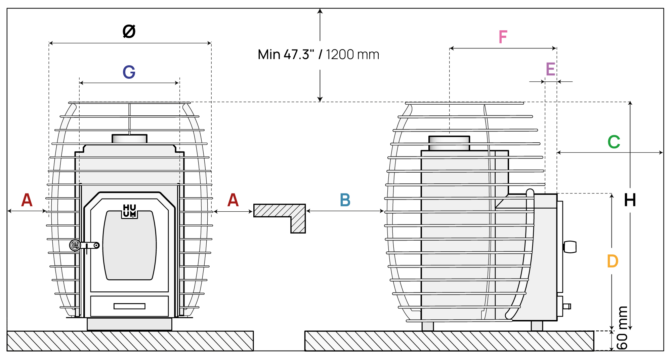

There should be at least 2.2 in / 50 mm between the wall of non-combustible material and the stove.
The safety distance for combustible materials can be reduced to 50% in the case of a single and 25% in the case of a double heat barrier. The heat barrier is considered within the safety distance, and the difference between the outer surface and the protected area must be at least 30 mm.
The safety distance between the sauna stove and the ceiling can be reduced by 25% by using the single protective screen. The double protective screen is not used in the ceiling.
- HIVE Wood heater;
- metal grate;
- installation and operation manual;
- heat-resistant glove;
- ash grate;
- cleaning hatches (2 pcs);
- ash drawer;
Sauna stones and connection with the chimney are not included and must be purchased separately.
NB! The connection between the sauna stove and the flue can only be made by a certified installation expert.
The flue gas outlet of HIVE Wood is at the top of the sauna stove. The sauna stove is connected to the chimney using special metal flue pipes, which are optionally sealed with heatresistant
sealing rope.
What to keep in mind when installing:
- The elbows of the connection tubes must be smooth to keep draught loss to a minimum.
- The tube is inserted through the wall of the chimney and sealed with mineral wool.
- The flue gases of the stove must be directed into a separate flue.
- Use of a common flue with other furnaces is not permitted.
ATTENTION! Forced extract ventilation may cause problems with the ventilation of the room and inadequate furnace combustion, therefore, designing and building such a ventilation system is permitted only with the supervision of a licensed specialist.
HIVE Wood 13 sauna stove requires 198.4 lb / 90 kg of stones with a fraction of 2-4 in / 5-10 cm. HIVE Wood 17 holds 298 lb / 135 kg of stones with a fraction of 2-4 in / 5-10 cm. With the stone cage you can add an additional 35-40 kg of stones.
It is recommendable to use round stones in HUUM sauna heaters. Round stones complement the design of the heaters and provide milder steam. Our product range includes round olivine diabase sauna stones and are sold in packs weighing 33 lb / 15 kg.
NB! Choose stones that are specifically meant for use in sauna heaters, and avoid decorative stones as they may break easily.
1. Wash the stones under running water to remove dust before use.
2. Lay the stones one by one. Don’t pour or throw them into the heater!
3. Start with larger stones at the bottom and sides, then use smaller stones to fill gaps. Lay the stones tightly but leave space for air circulation.
4. Cover the outer surfaces of the heater tightly, ensuring the heating elements are not visible. Exposing them to water shortens their lifespan and creates excessively sharp heat.
You can find the user manual here.
Heating
The sauna stove can only be heated with wood logs. For HIVE Wood 13 logs with a length of 11.8 in / 30 cm are the best and for HIVE Wood 17 logs with a length of 15.7 in / 40 cm.
The amount of air combustion is adjusted by changing the position of the ash tray drawer.
During ignition, it is advisable to keep the ash tray open by up to 10 mm. As the material ignites, close the ash tray to the point where the distance between the front of the tray and the wall is 0.08-0.12 in / 2-3 mm, depending on the draught.
Keep the furnace door closed during heating. Open the door only to add firewood.
NB! Avoid overheating the sauna stove; overheating is indicated when the furnace case glows red. Overheating causes the metal to deform, and the manufacturer is not responsible for this defect.
Throwing water on the hot sauna stones enables you to raise the humidity and the apparent temperature according to your preferences.
- Sauna stones must be hot
The time is right for throwing the water on sauna stones when the stones are hot enough for complete vaporization of the water. You can try this by throwing a small amount of water.
- Use clean and warm water to add the steam
It is wise to use hot tap water to prevent the stones from breaking from the abrupt temperature change.
- Use a small amount of water at once
We recommend throwing approximately 80 ml of water at a time. If you desire more steam, wait a few minutes and throw the same amount of water on the sauna stones. This allows the stones to dry in the meantime and regain their heat. If you notice that water runs out from the bottom of the heater, it means you have poured too much water or that the stones are not hot enough.
Regularly emptying the ash drawer is crucial for the efficient and safe operation of wood-burning heaters. Always check and empty the ash drawer before each use to ensure the heater operates safely, efficiently, and reliably.
A full or partially full ash drawer can lead to the following issues:
- Airflow obstruction: If ash blocks airflow under the grate, the combustion process will suffer. This reduces the heater’s efficiency and increases fuel consumption.
- Excessive heat: Accumulated ash can cause the grate to overheat. Prolonged exposure to excessive heat may deform the grate, make it brittle, or even lead to metal burnout.
- Material damage: Chemical compounds and carbon residues in ash can react with the metal surface at high temperatures, accelerating corrosion and reducing the lifespan of the grate.
If the sauna stove surface turns red, it is overheating. Close the ash tray immediately to reduce combustion intensity. The manufacturer is not responsible for any damage caused by overheating.
Troubleshooting
Possible reasons for this:
Damp or too thick firewood: Use dry firewood with 10-15% moisture content for efficient burning. Cut firewood to the recommended size: 30-40 cm, ideal weight: 0.4–0.7 kg per log.
Wrong dimensioning: Check if the sauna stove’s power matches the room’s cubic capacity. Replace the stove with a more powerful model if necessary. Ensure proper insulation of the sauna room to retain heat efficiently.
Ventilation errors: Ensure there is adequate ventilation without creating underpressure; adjust or repair the air vents as needed.
Outside temperature also plays a significant role in heating time. When the temperature is below 10°C, heating the sauna can take up to 3 hours. This is because, with wood-burning heaters, heat starts at the center of the heater and radiates outward until all the stones are hot. Once the stones are fully heated, the heat will spread into the sauna room.
Possible reasons for this:
Damp flue or stones: Preheat the flue by lighting a small amount of dry paper or kindling in the stove to warm the chimney and improve airflow. Ensure the sauna room is warm and dry before firing the stove.
Insufficient air supply or underpressure: The sauna room may not get enough air, or ventilation may create underpressure (e.g., when a kitchen hood is in use).
Leaking connection pipe: Inspect the connection pipe for any gaps or damage and seal them with heat-resistant materials if necessary. Replace damaged pipes or joints to restore proper draft.
Incorrect chimney height or diameter: A chimney that is too short, narrow, or improperly built may hinder draft performance. Check the chimney measurements.
Weather conditions: Strong winds, low air pressure, or cold weather can negatively affect the draft.
Pre-installation heating has not been done: Perform a pre-installation heating process (See Pre-installation instructions in the manual).
The sauna stones have not been washed before installation or grease or dirt has accumulated on the stones: Remove the sauna stones, thoroughly wash them with clean water, and allow them to dry completely before placing them back in the stove. This removes dust, dirt, or residues from the stones.
Steam water is not clean: Avoid using water that contains impurities, detergents, or oils. If needed, clean the water container or piping to ensure there is no contamination affecting the steam quality.
Keep the ash drawer closed during heating. An open ash drawer allows excessive airflow, intensifying the fire and causing the stove to overheat. Open it only when cleaning or to adjust the fire briefly.
Consult a professional to inspect and adjust the chimney height or configuration.
Use properly sized and seasoned firewood (not too thin or overly dry). Thicker logs burn slower and more evenly, preventing excessive heat buildup. Avoid using kindling or thin firewood for prolonged heating.
Avoid overloading the stove. Follow the manufacturer’s guidelines for the optimal amount of firewood per batch and the correct waiting time between additions.
Opening the stove door during the intense burning phase is not allowed!
If it is necessary for some reason, first open the door a few millimeters for 10 seconds. Then you can open the door as much as necessary.
Sooting of the glass during oven ignition is normal. It is caused by humidity in the air and cold surfaces where water condenses.
How to avoid it?
When starting the heating, keep the door slightly open by a couple of millimeters for the first few minutes to allow the surfaces to dry, and then close the door completely.
Another cause may be that the wood used for heating is too moist. If possible, store/dry the wood indoors.
Maintenance
Sauna stones don’t last forever. Contact with water and temperature fluctuations have an impact, and over time they eventually start crumbling. Therefore it is natural that every now and then they should be replaced with new stones.
Check the condition of sauna rocks once a year or after 300 hours of heating. If you heat your sauna three times a week on average, you should replace the sauna stones once a year. If you use your sauna less frequently, you should exchange the sauna stones once every couple of years.
- Empty the ash drawer before each heating since it is used for adjusting the draft.
- Clean the heating surfaces of the furnace regularly, at least once after 20 uses.
- At least once a year ask a specialist to clean the chimney and the flue.
- Clean the door glass regularly, ideally before each heating. Use special fireplace glass cleaners or a moistened paper towel dipped in fine white ash to scrub away soot. Finish by wiping the glass clean and dry with a fresh paper towel.
Installation
The manufacturer’s warranty guarantee is invalid if the heater and sauna room have been dimensioned incorrectly!
1) Does the output (kW) match the volume (m3) of the sauna room?
In case there are any uninsulated brick, tile or glass walls in the sauna room, an additional volume of 3.3 ft3 / 1 m3 should be added to the sauna room for each square meter of the wall.
Use our sauna calculator to find the heater power best suited to the estimated volume of your steam room.
2) Check the safety distances to ensure safe installation
Maintaining proper safety distances around sauna heaters is essential for ensuring safe operations and user safety. Sauna heaters can reach very high temperatures. Ensuring a safe distance minimizes the risk of accidental burns, overheating, or ignition of nearby objects.
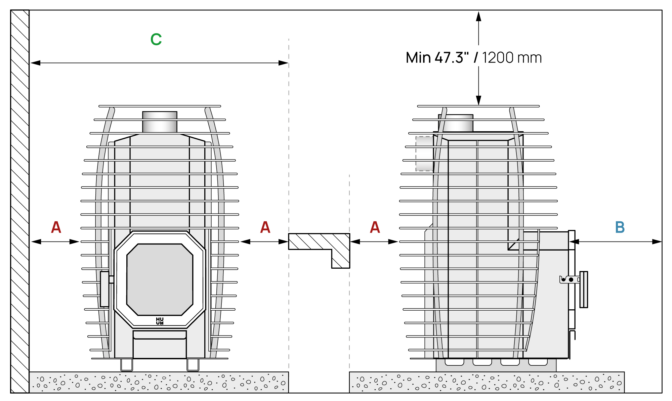

There should be at least 2.2 in / 50 mm between the wall of non-combustible material and the stove.
Safety distances can be reduced by using reflective screens made of non-combustible material. The single-layer light protective screen allows to reduce the safety distances by 50% and the double light protective screen by up to 75%. The protective screen is included in the safety distance, which means that the distance is measured to the flammable material, not to the protective screen. There should be a gap of at least 50 mm between the protective screen and the sauna stove.
The safety distance between the sauna stove and the ceiling can be reduced by 25% by using the single protective screen. The double protective screen is not used in the ceiling.
- HIVE Flow heater;
- metal grate;
- installation and operation manual;
- heat-resistant glove;
- splints;
- metal fixing plates (2 pcs);
- ash grate;
- cleaning hatches (2 pcs);
- ash drawer;
Sauna stones and connection with the chimney are not included and must be purchased separately.
NB! The connection between the sauna stove and the flue can only be made by a certified installation expert.
HIVE Flow sauna stove can be connected to the flue both from the top and back of the sauna stove. To connect from the back, the positions of the bolted chimney leg and cover plate should be changed.
HIVE Flow back connection. The two ribs should be cut according to the diameter of the chimney element and the loose ends of the ribs should be fixed with the metal fixing plates found in the package.
The sauna stove must be heated outdoors at least once while following general fire safety precautions to ensure that the heat-resistant paint is properly tempered.
This is necessary as the protective paint layer of the body of the sauna stove emits harmful and unpleasant-smelling fumes during the first heating. The paint gains durable properties during the first heating.
Assembling the stove for pre-installation heating. Read more about HIVE Flow.
HIVE Flow sauna heater requires 150 kg of sauna stones with a fraction of 2-4 in / 5–10 cm. With the stone cage, you can add an additional 77-88 lb / 35-40 kg of stones.
HIVE Flow Mini and Mini LS hold 105 kg of stones.
It is recommendable to use round stones in HUUM sauna heaters. Round stones complement the design of the heaters and provide milder steam. Our product range includes round olivine diabase sauna stones and are sold in packs weighing 33lb / 15 kg.
NB! Choose stones that are specifically meant for use in sauna heaters, and avoid decorative stones as they may break easily.
- Wash the stones under running water to remove dust before use.
- Lay the stones one by one. Don’t pour or throw them into the heater!
- Start with larger stones at the bottom and sides, then use smaller stones to fill gaps. Lay the stones tightly but leave space for air circulation.
- Cover the outer surfaces of the heater tightly, ensuring the heating elements are not visible. Exposing them to water shortens their lifespan and creates excessively sharp heat.
You can find the user manual here.
Heating
NB! Make sure the pre-installation heating is done before the first sauna session.
Keep the ash drawer open for up to 15 minutes after lighting. The ash drawer has a limiter that prevents it from being opened more than 0.12 in / 3 mm.
The hearth door can be kept open for approximately 2 minutes after lighting. A few millimeters are enough. This reduces moisture condensation and soot sticking to the door glass.
Fully open the air valve under the stove’s front edge. If the fire burns too intensely, reduce the burning speed by adjusting the valve.
Throwing water on the hot sauna stones enables you to raise the humidity and the apparent temperature according to your preferences.
Sauna stones must be hot
The time is right for throwing the water on sauna stones when the stones are hot enough for complete vaporization of the water. You can try this by throwing a small amount of water.
Use clean and warm water to add the steam
It is wise to use hot tap water to prevent the stones from breaking from the abrupt temperature change.
Use a small amount of water at once
We recommend throwing approximately 80 ml of water at a time. If you desire more steam, wait a few minutes and throw the same amount of water on the sauna stones. This allows the stones to dry in the meantime and regain their heat. If you notice that water runs out from the bottom of the heater, it means you have poured too much water or that the stones are not hot enough.
Regularly emptying the ash drawer is crucial for the efficient and safe operation of wood-burning heaters. Always check and empty the ash drawer before each use to ensure the heater operates safely, efficiently, and reliably.
A full or partially full ash drawer can lead to the following issues:
- Airflow obstruction: If ash blocks airflow under the grate, the combustion process will suffer. This reduces the heater’s efficiency and increases fuel consumption.
- Excessive heat: Accumulated ash can cause the grate to overheat. Prolonged exposure to excessive heat may deform the grate, make it brittle, or even lead to metal burnout.
- Material damage: Chemical compounds and carbon residues in ash can react with the metal surface at high temperatures, accelerating corrosion and reducing the lifespan of the grate.
If the sauna stove surface turns red, it is overheating. Close the air valve immediately to reduce combustion intensity. The manufacturer is not responsible for any damage caused by overheating.
Troubleshooting
Possible reasons for this:
Damp or too thick firewood: Use dry firewood with 10-15% moisture content for efficient burning. Cut firewood to the recommended size: 12-16 in / 30-40 cm, ideal weight: 0.4–0.7 kg per log.
Wrong dimensioning: Check if the sauna stove’s power matches the room’s cubic capacity. Replace the stove with a more powerful model if necessary. Ensure proper insulation of the sauna room to retain heat efficiently.
Ventilation errors: Ensure there is adequate ventilation without creating underpressure; adjust or repair the air vents as needed.
Outside temperature also plays a significant role in heating time. When the temperature is below 10°C, heating the sauna can take up to 3 hours. This is because, with wood-burning heaters, heat starts at the center of the heater and radiates outward until all the stones are hot. Once the stones are fully heated, the heat will spread into the sauna room.
Possible reasons for this:
Damp flue or stones: Preheat the flue by lighting a small amount of dry paper or kindling in the stove to warm the chimney and improve airflow. Ensure the sauna room is warm and dry before firing the stove.
Insufficient air supply or underpressure: The sauna room may not get enough air, or ventilation may create underpressure (e.g., when a kitchen hood is in use).
Leaking connection pipe: Inspect the connection pipe for any gaps or damage and seal them with heat-resistant materials if necessary. Replace damaged pipes or joints to restore proper draft.
Incorrect chimney height or diameter: A chimney that is too short, narrow, or improperly built may hinder draft performance. Check the chimney measurements.
Weather conditions: Strong winds, low air pressure, or cold weather can negatively affect the draft.
Pre-installation heating has not been done: Perform a pre-installation heating process (See Pre-installation instructions in the manual).
The sauna stones have not been washed before installation or grease or dirt has accumulated on the stones: Remove the sauna stones, thoroughly wash them with clean water, and allow them to dry completely before placing them back in the stove. This removes dust, dirt, or residues from the stones.
Steam water is not clean: Avoid using water that contains impurities, detergents, or oils. If needed, clean the water container or piping to ensure there is no contamination affecting the steam quality.
Keep the ash drawer closed during heating. An open ash drawer allows excessive airflow, intensifying the fire and causing the stove to overheat. Open it only when cleaning or to adjust the fire briefly.
Consult a professional to inspect and adjust the chimney height or configuration.
Use properly sized and seasoned firewood (not too thin or overly dry). Thicker logs burn slower and more evenly, preventing excessive heat buildup. Avoid using kindling or thin firewood for prolonged heating.
Avoid overloading the stove. Follow the manufacturer’s guidelines for the optimal amount of firewood per batch and the correct waiting time between additions.
Opening the stove door during the intense burning phase is not allowed!
If it is necessary for some reason, first open the door a few millimeters for 10 seconds. Then you can open the door as much as necessary.
Sooting of the glass during oven ignition is normal. It is caused by humidity in the air and cold surfaces where water condenses.
How to avoid it?
When starting the heating, keep the door slightly open by a couple of millimeters for the first few minutes to allow the surfaces to dry, and then close the door completely.
Another cause may be that the wood used for heating is too moist. If possible, store/dry the wood indoors.
Maintenance
Sauna stones don’t last forever. Contact with water and temperature fluctuations have an impact, and over time they eventually start crumbling. Therefore it is natural that every now and then they should be replaced with new stones.
Check the condition of sauna rocks once a year or after 300 hours of heating. If you heat your sauna three times a week on average, you should replace the sauna stones once a year. If you use your sauna less frequently, you should exchange the sauna stones once every couple of years.
- Empty the ash drawer before each heating since it is used for adjusting the draft.
- Clean the heating surfaces of the furnace regularly, at least once after 20 uses.
- At least once a year ask a specialist to clean the chimney and the flue.
- Clean the door glass regularly, ideally before each heating. Use special fireplace glass cleaners or a moistened paper towel dipped in fine white ash to scrub away soot. Finish by wiping the glass clean and dry with a fresh paper towel.
For the HIVE FLOW sauna stove, check the condition of the door seal every time you clean the glass. If the door seal is damaged or comes loose, the sauna stove should not be heated. Without a seal, the combustion process receives too much air, which can cause overheating. The door seal can be replaced. You can order a suitable seal and glue as HUUM’s spare parts.
Heater accessories
Yes, we recommend using protective railings with your sauna heater, especially in smaller or more compact sauna spaces where the risk of accidental contact is higher. Protective railings provide an important layer of safety. However, it’s important to note that while protective railings significantly enhance safety, they do not eliminate all risks.